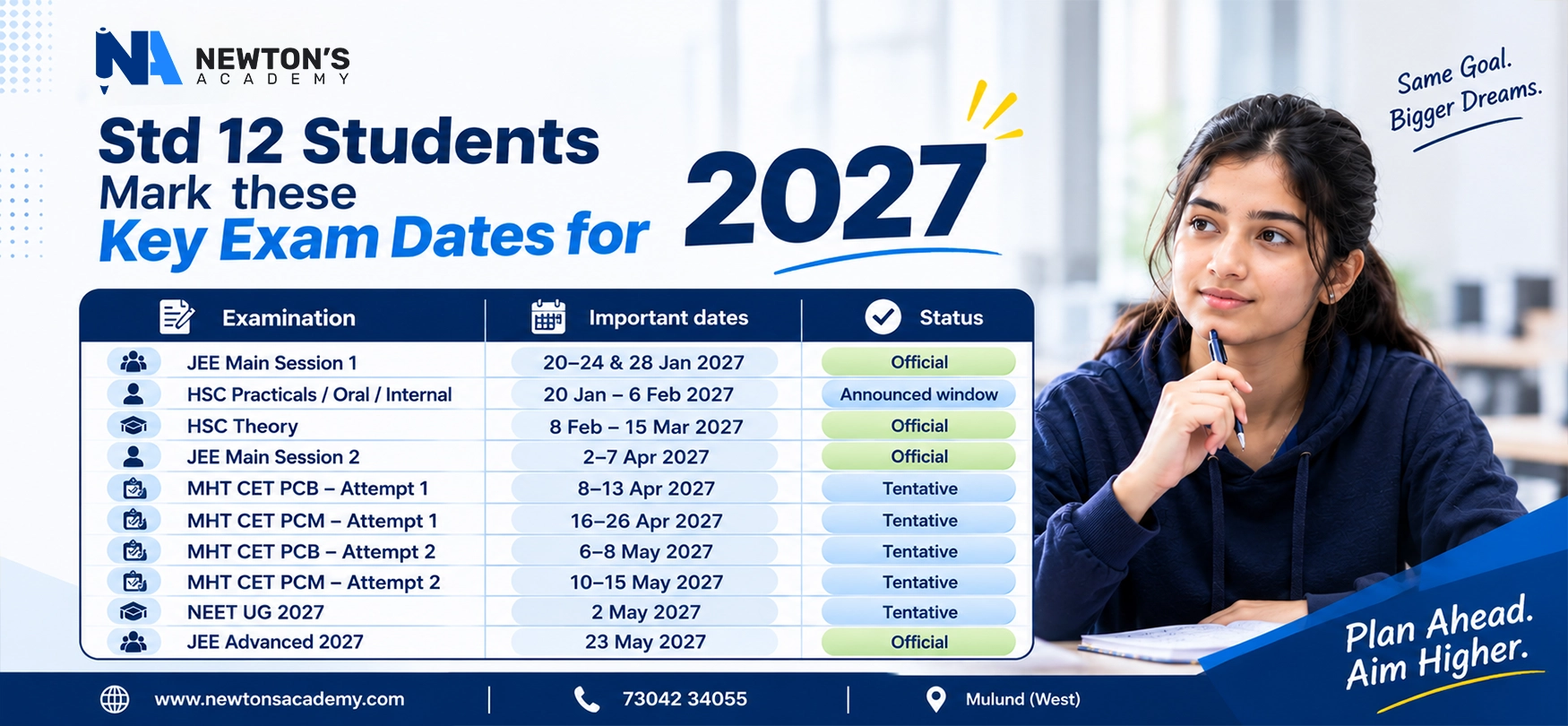

If you are a NEET aspirant in Mulund, you are preparing for an exam that is changing in a meaningful way. NEET UG is moving to a Computer-Based Test (CBT) from 2027, and the exam is expected to be held in the first week of May 2027—tentatively May 2, 2027. For students in Mulund West, Mulund East, Bhandup, Nahur and Thane, the question is not just what to study, but how to prepare in a way that fits the realities of school, travel, boards and a new digital exam format.
This guide breaks down what has actually been confirmed, which chapters carry the most weight, how to balance HSC boards with NEET, and what to look for in a local coaching class before you commit.
What is actually changing for NEET 2027?
The biggest confirmed change is the shift from pen-and-paper OMR to a computer-based test. The Union Education Minister has confirmed that NEET-UG will be conducted in CBT mode from 2027 onward, with the old OMR sheets being phased out. The syllabus and the 720-mark pattern are not expected to change significantly, but the experience of the exam will be different.
That matters for Mulund students because most school and coaching practice is still paper-based. Reading questions on a screen, managing a digital timer, scrolling between sections, and marking answers with a mouse are separate skills. If your preparation has been entirely on paper until now, you need to start practising on a screen well before the final months.
The NEET 2027 notification and detailed syllabus are expected between December 2026 and April 2027, with applications beginning in the first week of February 2027. Until then, the rationalised NCERT syllabus remains your safest guide.
Which chapters actually decide your NEET score?
NEET does not reward equal effort across all chapters. A small number of topics consistently carry a large share of the marks.
Biology (the highest-weightage subject)
Biology carries 360 marks out of 720, and a few chapters dominate it.
Botany high-weightage chapters:
Molecular Basis of Inheritance - 15%
Inheritance & Variation - 9%
Cell Cycle & Division - 8%
Plant Kingdom - 7%
Zoology high-weightage chapters:
Biotechnology (Principles) - 13%
Animal Kingdom - 10%
Biomolecules - 10%
Human Reproduction - 8%
Human Physiology consistently emerges as one of the most significant units, with sources placing it at roughly 12–16% of the Biology paper. Genetics and Evolution and Ecology also carry 10–12% each.
For a Mulund student, the practical implication is simple: do not spend equal time on every chapter. Start with Molecular Basis of Inheritance, Genetics, Human Physiology, Biotechnology and Ecology. These chapters are not just high-weightage-they are also largely NCERT-derived, which means your board preparation and NEET preparation overlap here.
Physics and Chemistry
Physics rewards conceptual clarity in Current Electricity, Electrostatics, Optics and Modern Physics, which together cover a large share of the paper. In Chemistry, Organic Chemistry gives the most reliable marks because reaction-based questions repeat frequently; Aldehydes, Ketones and Carboxylic Acids alone carry around 9% weightage.
How to balance HSC boards with NEET in Mulund
This is the question parents in Mulund ask most often, and it has a practical answer: finish the Class 12 syllabus by December, run Class 11 revision alongside it, switch to board-style writing for about six weeks before the HSC exams, and then give every remaining day to NEET mocks and revision.
The overlap between Maharashtra HSC Biology and NEET Biology is substantial-roughly 85-90%. A student who has read NCERT Biology carefully for NEET already knows most of what the board asks; what differs is the format. NEET wants speed and precision on multiple-choice questions, while the board wants complete written answers with diagrams and derivations.
A phased plan that works for most Mulund students:
June to September: Main work is Class 12 chapters. Class 11 revision is one chapter a week, Biology first. Weekly chapter tests.
October to December: Finish Class 12 syllabus. Class 11 revision is two chapters a week. A full NEET mock every two weeks.
January to mid-February: Board mode: written answers, practicals. Light Class 11 revision, Biology NCERT only. Board sample papers, one NEET mock a week.
After boards to NEET: Full NEET revision. Two or three mocks a week with analysis.
One non-negotiable: do not treat boards casually. For Maharashtra state-quota MBBS and BDS admission, Open and EWS candidates needed at least 50% in Physics, Chemistry and Biology together in Class 12, and reserved-category candidates needed 40%. The exact rule for your year will be in that year's brochure, but the principle holds-board marks are not optional for a NEET student.
The CBT challenge: what Mulund students should start doing now
The move to CBT is the single biggest practical change for NEET 2027. Three habits will separate students who adapt from those who struggle:
-
Practise on a screen, not just on paper. Use NTA-pattern mock tests delivered in a browser. Get used to the on-screen calculator, the question palette, and the way the timer behaves when you switch sections.
-
Train your reading speed on a screen. Many students read more slowly on a monitor than on paper. A weekly timed screen-based reading exercise-even 20 minutes-builds the habit.
-
Simulate the real environment. Sit mock tests at the same time of day as the actual exam, with no phone and no interruptions. The goal is not just content accuracy but stamina and familiarity.
This is exactly where a local coaching class can add value that an online-only course often cannot: supervised screen-based mock sessions, in a room with other students, followed by a face-to-face discussion of what went wrong.
What to look for in a NEET coaching class in Mulund
Mulund has no shortage of NEET coaching options-Aakash, ALLEN, Revolution Educare, Jeeneeus Mindz and others all operate in or around Mulund West. Parents comparing them should ask five specific questions, not just look at the fee or the brand name.
-
What is the actual batch size?
A batch of 30 students is a different learning experience from a batch of 80. Ask for the number, not a range. Ask whether the batch list is published on day one. -
Who teaches Biology, and for how many years?
Biology decides most NEET ranks. Ask for the name, qualification and teaching experience of the Biology faculty specifically. “IIT/AIIMS-trained faculty” is a claim; a named teacher with a track record is evidence. -
How does doubt-solving actually work?
“24/7 doubt support” is a common claim. Ask how it works: is there a WhatsApp group? What is the typical response time? Can a student walk in without an appointment? A vague answer usually means the support is thin. -
How often are full-length NEET mocks conducted, and how are they reviewed?
A mock test without a structured review is just a score. Ask whether every wrong answer is discussed, and whether parents receive a test report. -
How does the coaching handle the board - NEET balance?
A good Mulund coaching class should already have a plan for the January - February board period, not a generic “we cover both” answer. Ask what happens to NEET preparation during HSC practicals and board exams.
If a class cannot answer these five questions clearly, the fee is not the real issue.
A realistic weekly routine for a Mulund NEET aspirant
Most Mulund students travel to school and coaching, which means study time is fragmented. A workable routine looks like this:
Weekdays: 2 hours of focused self-study after coaching, split between Biology NCERT reading and one problem-solving subject (Physics or Chemistry).
Saturday: One chapter test and a review of every wrong answer.
Sunday: One full-length or sectional mock (screen-based), followed by a 45-minute analysis session.
One evening per week: Doubt-clearing, either at the coaching centre or with a teacher, rather than saving doubts for the week before the exam.
The goal is consistency, not marathon sessions. A student who does two focused hours every day for ten months will outperform a student who does eight hours only in the final month.
The bottom line for Mulund families
NEET 2027 rewards three things: early clarity on high-weightage chapters, deliberate practice for the CBT format, and a board plan that does not collapse under HSC pressure. A local coaching class can help with all three-but only if you ask the right questions before you enrol.
If you are in Mulund West and want to see how a small-batch NEET programme actually runs—with named faculty, weekly tests and doubt sessions six days a week-book a free demo class at Newton’s Academy. Sit through a session, meet the Biology teacher, and ask the five questions above. The right class will welcome them.
Call 73042 34055 to book a demo slot.